
Internal control is the system of policies, procedures and activities an organisation uses to manage risk and provide reasonable assurance that it will achieve its objectives. It covers everything from authorisation limits and segregation of duties to reconciliations, monitoring and board oversight.
For UK organisations, internal control has moved firmly onto the boardroom agenda. Under the 2024 UK Corporate Governance Code, boards are expected to declare the effectiveness of their material controls for financial years beginning on or after 1 January 2026. This guide sets out what that means in practice for boards, audit committees, CFOs, CEOs, risk managers and governance leaders, and links to deeper guidance across each area.
What Is Internal Control?
It is the framework of measures management designs and operates to safeguard assets, ensure reliable reporting, support compliance and keep risk within acceptable limits.
It is not a single document or a one-off project. It is a living system, made up of many individual controls, that should operate consistently across every part of the organisation.
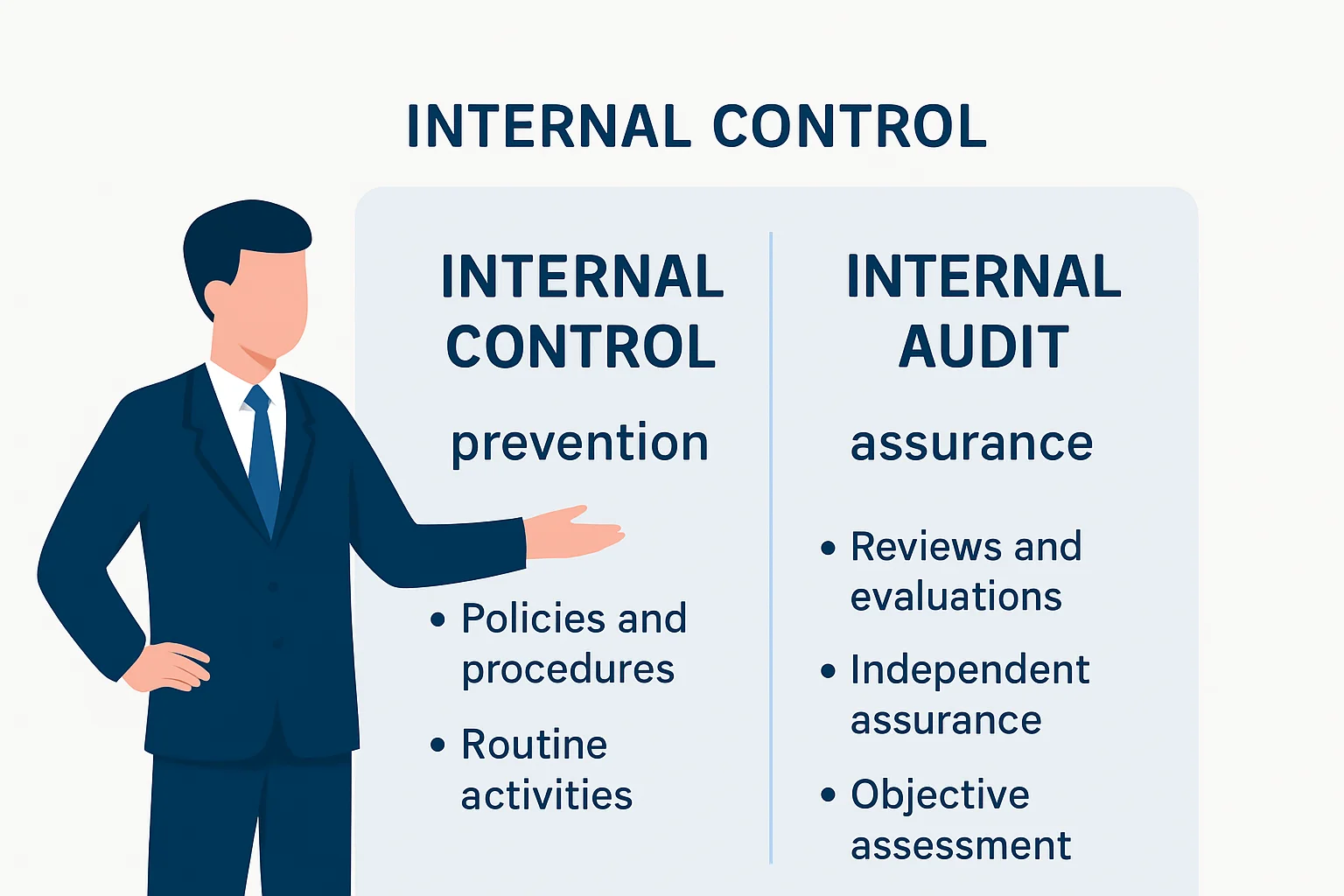
A useful distinction: management runs this system every day, while assurance over it comes from independent review. Both are needed for a board to have genuine confidence.
Why Internal Control Matters
It matters because it protects the organisation from fraud, error, regulatory breach and poor decisions, and gives the board evidence that the business is being run as intended.
Weak controls rarely announce themselves. They surface as a fraud that should have been prevented, a misstatement that should have been caught, or a breach that a simple review would have flagged.
Strong controls also underpin effective risk management, turning the board’s risk appetite into practical, day-to-day safeguards rather than statements on paper.
Objectives
At a high level, controls exist to safeguard assets, ensure reliable financial reporting, maintain compliance, prevent and detect fraud, manage risk, improve efficiency, support decisions and strengthen governance.
These objectives are the criteria auditors test against. We explore each one, and how UK organisations evidence them, in our detailed guide to the objectives of internal control in auditing.
Types of Controls
Controls are usually grouped as preventive, detective and corrective. Preventive controls stop problems before they occur, detective controls identify issues that have already happened, and corrective controls put them right and prevent recurrence.
Most frameworks, including the widely used COSO Internal Control – Integrated Framework, organise these controls within a broader structure of environment, risk assessment, control activities, information and monitoring. A full breakdown is available in our guide to the types of internal control in auditing.
Internal Control vs Internal Audit
Internal control and internal audit are often confused: one is the system itself; the other is the independent function that tests whether that system works.
| Dimension | Internal Control | Internal Audit |
|---|---|---|
| What it is | The system of controls itself | Independent review of that system |
| Responsibility | Management and the board | Internal audit function, reporting to the audit committee |
| Frequency | Operates continuously | Periodic, risk-based reviews |
| Purpose | Manage risk day to day | Provide objective assurance |
| Independence | Embedded in operations | Independent of the activities it reviews |
In practice, an independent internal audit gives the board confidence that controls are not just designed well but operating effectively.
Internal Control vs Internal Check
An internal check is a narrower idea: a specific arrangement where one employee’s work is automatically verified by another during routine processing, such as separating the person who records sales from the one who banks the cash.
An internal check is therefore one mechanism within the wider control system, not a substitute for it. Strong checks at transaction level are valuable, but they cannot address strategic, IT or management-override risks on their own. We unpack this fully in our guide to the difference between internal check and internal control.
Common Control Weaknesses
The weaknesses we see most often during UK audit engagements include:
- Poor segregation of duties, especially in lean teams.
- Management override of otherwise sound controls.
- Controls that exist on paper only and are not consistently performed.
- Over-reliance on detective controls that catch problems late.
- Weak monitoring, with no independent confirmation that controls still work.
- Untested IT and access controls as processes automate.
Expert insight. The most common finding in our reviews is not a missing control but a control that exists only on paper. A reconciliation done weeks late, or an approval given without scrutiny, offers no real assurance. Genuine control is about behaviour and evidence, not documentation, which is why operating effectiveness matters as much as design.
Internal Control Best Practices
Effective control comes down to a few disciplines: weight controls towards prevention, map every control to a real risk, enforce segregation of duties, keep detective controls timely and independent, and close the loop on every finding.
For a fuller, actionable treatment, see our guide to internal control best practices.
Role of Boards and Audit Committees
Boards and audit committees carry ultimate responsibility for internal control. Under the UK Corporate Governance Code, the audit committee reviews the organisation’s control and risk management systems, and the board monitors them and, from 2026, declares the effectiveness of material controls.
That accountability is personal as well as collective. Directors who can evidence that their control objectives are being met are far better placed to protect value, satisfy regulators and make confident decisions. Those who cannot are exposed.
Control Checklist
Use this checklist to gauge the health of your control environment.
- Material controls are identified and mapped to principal risks.
- Controls are weighted towards prevention rather than detection.
- Segregation of duties is enforced, including in small teams.
- Reconciliations and reviews are timely, independent and actioned.
- Audit findings are tracked through to confirmed remediation.
- IT and access controls are tested, not assumed.
- Controls are documented so they survive staff turnover.
- The audit committee receives clear, prioritised reporting on control effectiveness.
Conclusion
Strong internal control is what separates an organisation that looks well run from one that genuinely is. It protects assets, supports reliable reporting, satisfies regulators and gives leaders the confidence to make decisions on information they can trust, benefits that compound as a business grows.
The organisations that get this right treat it as a living system, tie every control to a real risk, and confirm independently that it works.
Albion Audit helps UK boards and audit committees achieve exactly that, combining internal audit, risk management, corporate governance advisory and compliance and assurance services to strengthen controls and provide credible, independent assurance. If your board needs confidence that its control environment is fit for scrutiny, speak to our internal audit team for a no-obligation conversation.
Internal controls are the policies and procedures used to prevent risks and ensure operational efficiency, while internal audit provides independent assurance that these controls are designed and operating effectively.
Internal controls safeguard assets, reduce operational and financial risks, support accurate reporting, maintain compliance with regulations, and strengthen governance across the organisation.
Common internal controls include segregation of duties, access rights management, reconciliations, approval workflows, exception reporting, policy documentation, and corrective action procedures.
What is the difference between internal control and internal audit?
Why are internal controls important?
What are examples of internal controls?