

The difference between internal check and internal control is one of scope. An internal check is a specific arrangement built into daily work, where one employee’s task is automatically verified by another, while internal control is the entire system of policies and procedures an organisation uses to manage risk. In short, internal check is one component within the wider framework of internal control.
For UK boards, audit committees and finance leaders, the distinction is more than terminology. Under the 2024 UK Corporate Governance Code, boards are expected to declare the effectiveness of their material internal controls from financial years beginning on or after 1 January 2026, so understanding where internal checks sit within that system matters for assurance and accountability.
What Is Internal Check?
An internal check is an arrangement of duties whereby the work of one person is independently and automatically verified by another in the ordinary course of business.
Its defining feature is that the verification happens as part of the workflow, with no separate effort. For example, the employee who records sales is different from the one who banks the cash, so each person’s work acts as a check on the other’s.
Internal checks are preventive and detective by nature, designed to catch errors and routine fraud at the point a transaction is processed.
What Is Internal Control?
Internal control is the complete system of policies, procedures and activities management uses to provide reasonable assurance that the organisation will meet its objectives.
It spans financial, operational and compliance controls, from authorisation limits and reconciliations to monitoring and governance. An internal check is simply one mechanism within this broader system. For the full picture, see our guide on what internal control is.
Difference Between Internal Check and Internal Control
The two concepts are related but operate at very different levels, as the table makes clear.
| Dimension | Internal Check | Internal Control |
|---|---|---|
| Purpose | Catch errors and fraud automatically as work is done | Provide overall assurance that objectives are met |
| Scope | Narrow, built into transaction processing | Broad, covering the whole organisation |
| Responsibility | Operational staff, embedded in their roles | Management and the board |
| Risk Coverage | Transaction-level errors and fraud | All principal risks: financial, operational, compliance |
| Fraud Prevention | Strong against routine transaction fraud through division of work | Comprehensive, including senior-level and override risk |
| Governance Impact | Indirect; supports the control system | Direct; tied to board accountability under the UK Code |
| Audit Relevance | One area auditors test | The entire framework auditors assess |
| Control Environment | A mechanism operating within it | Defines and sustains it |
The simplest way to remember it: internal control is the system; internal check is one of the cogs inside it.
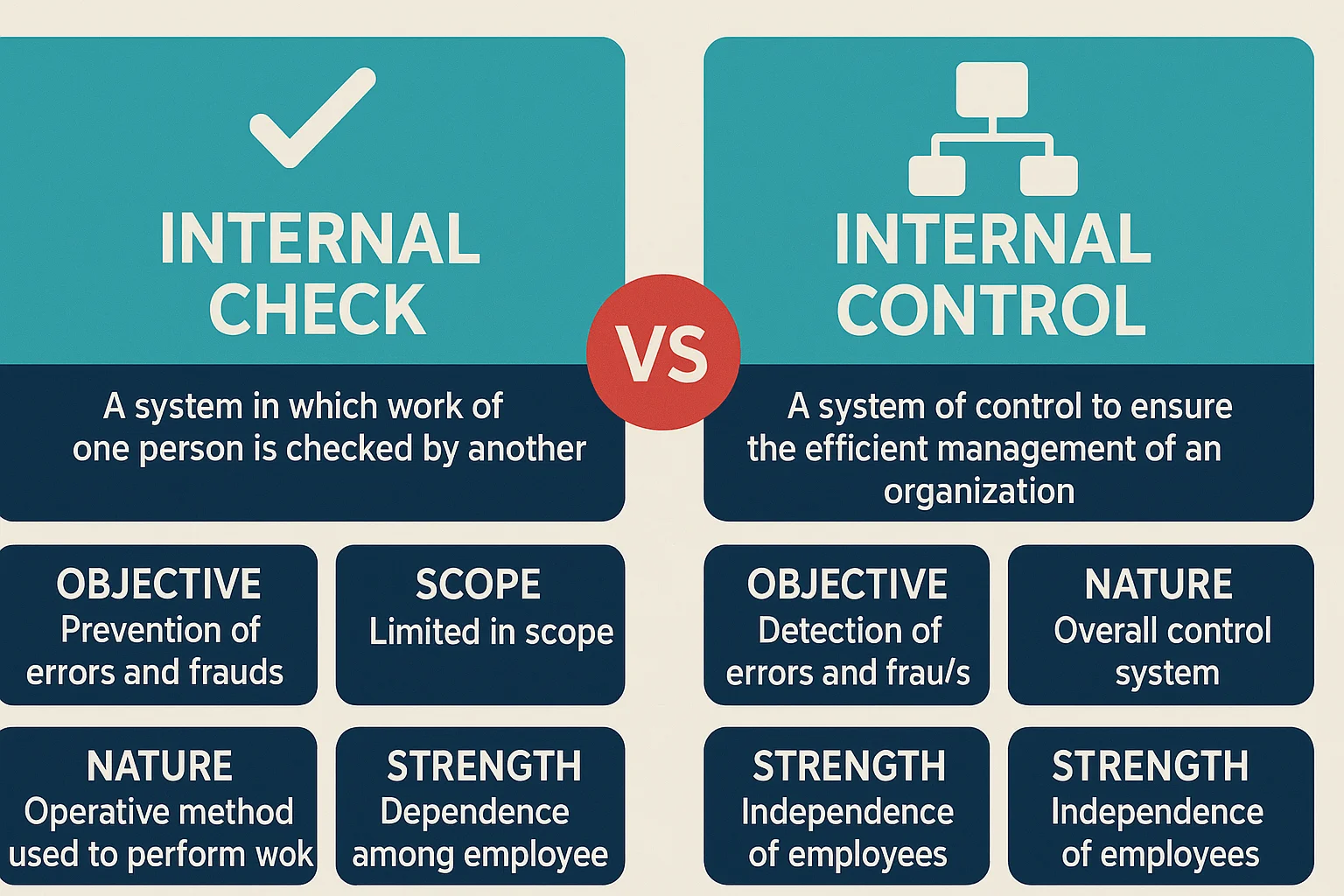
How Internal Checks Support Internal Controls
Internal checks are the everyday mechanism that makes a control system work at transaction level. By dividing duties so no single person can complete and conceal a transaction alone, they deliver segregation of duties, one of the most important preventive controls.
A strong control environment relies on many such checks operating consistently across processes. They sit mainly within the preventive and detective categories explained in our guide to the types of internal control in auditing, and they give management the front-line assurance that higher-level controls then build upon.
Practical Business Examples
In a UK SME, a common internal check is requiring two signatures on payments above a set value, so one manager’s authorisation is verified by another.
In a larger finance team, the person raising a purchase order is separated from the person approving the invoice and the person releasing payment, three checks that together form a control.
In a charity, the trustee who reviews the monthly bank reconciliation provides an internal check on the finance officer who prepared it, supporting the wider control framework the board is accountable for.
Common Misconceptions
The most common misconception about the difference between internal check and internal control is that the two terms are interchangeable. They are not: every internal check is a control, but not every control is an internal check.
A second misconception is that internal checks alone are enough. They are powerful at transaction level but cannot address strategic, IT or management-override risks, which require broader controls. Professional guidance from bodies such as the Institute of Internal Auditors makes clear that assurance must cover the whole control environment, not just routine processing.
Expert insight. In our audit engagements, organisations often have strong internal checks in finance but weak controls everywhere else, IT access, contract approval, data governance. They feel “in control” because the cash side is tight, yet their biggest exposures sit outside the areas internal checks reach. Genuine assurance means testing the full system, not just the checks that are easiest to see.
Which Is More Important for Organisations?
When weighing the difference between internal check and internal control, neither is more important; they operate at different levels and depend on each other. Internal checks without a wider control system leave major risks unmanaged, while a control framework without effective internal checks has no reliable foundation at transaction level.
For UK organisations, the practical goal is a control environment where well-designed internal checks feed into a broader, independently assured system of internal control that the board can stand behind.
Conclusion
Understanding the difference between internal check and internal control matters because the gap between them is where risk hides. Many organisations assume tight transaction checks mean they are well controlled, only to discover that strategic, IT or override risks were never covered, and by the time a weakness surfaces, the cost is often reputational as well as financial.
Independent internal audit is what closes that gap. An objective review confirms not only that internal checks operate, but that the wider control system genuinely manages the risks that matter.
Albion Audit helps UK boards and audit committees strengthen their controls, governance and risk management through specialist internal audit, risk and assurance services. If you want confidence that your control environment is fit for scrutiny, speak to our internal audit team for a no-obligation conversation.
Internal checks verify specific transactions for accuracy and immediate error detection, while internal controls are the broader framework that prevents risks, ensures compliance, and protects organisational assets.
Internal checks provide the detailed verification steps within a control framework, ensuring that policies and procedures are being followed effectively.
While possible, it is not recommended. Internal checks are essential to validate that controls are working as intended, especially in high-risk or operationally complex areas.
What is the difference between internal check and internal control?
How do internal checks strengthen internal control?
Can an organisation have internal control without internal checks?